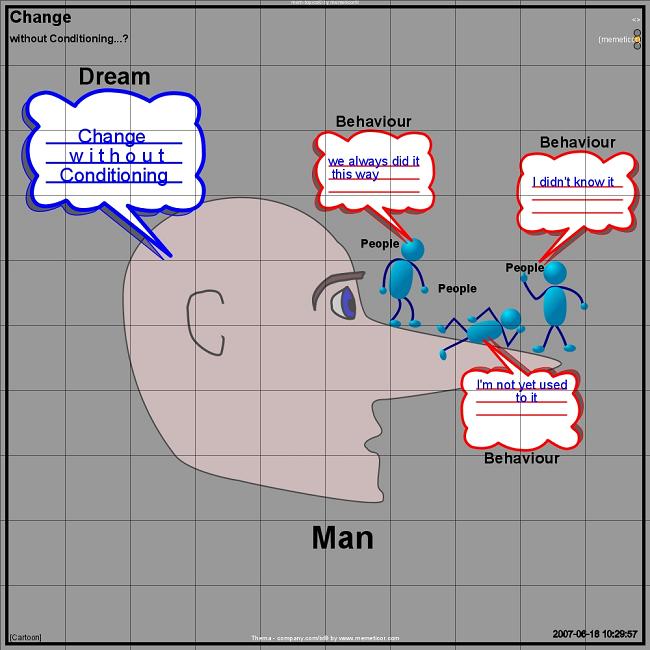
memeticor® - Change without Conditioning?
Do you belief in Change without Conditioning?.
Keep on dreaming...
No, we can not change the half-life period of changes either, but we can change the impact... !
What will you tell me, I will forget. What you will show me, I will remember. What you will let me do, I will understand. [Confucius]

Visit our speeches at TRIPLE-I '07: Press

<< In the previous newsletter: to be or not to be a human by knowledge << >> In the next newsletter: pattern recognition or sense by nonsense >>
Use our new RSS feeds for press and newsletter - follow these symbols with your RSS reader:  Press & Events - Newsletter
^^^
back
Change
of people...
vvv
next
Change means changing our behaviour !
Behaviour has to do with habit,
when did you change a habit recently ?
When did you demand from anybody else to change a habit ?

Stop smoking immediately !

Do you want to demand the impossible?
Why are processes of change in organisations such complex?
Why does the tail wag the dog so often finally?
  • Behaviour
    we are neural networks and our behaviour corresponds to our experience
  • Pattern
    we store these experiences as patterns
  • Habit
    because only then we can act efficiently, we need our habits
  • Knowledge
    we may bring new things to our mind, but we do know much more than we can put into action
  • Conditioning
    in order to change our self, we have to condition our self
and this needs iteration and corrections - so training.

Training costs time and money, thus it should be well coordinated:

mem-training© >>

But please read on what you should know about conditioning too...>>
^^^
back
Conditioning
does not happen spontaneous...
vvv
next
Conditioning means transition from consciousness to subconsciousness.
Without unconscious action we are not efficient.
  • Impulse:
    to arouse interest to change at all, we need an external impulse (stroke, pain, power surge...)
  • Willingness:
    the impulse have to fall on fertile ground, you can not pour into a full cup
  • Analysis:
    it must become obvious to us what we really want (e.g. by - good - consulting)
  • Action:
    we have to brace oneself up for doing "something" actually
  • Iteration:
    we must be able to "do" this "something" indeed, namely regularly
  • Control:
    only the Baron of the Lies was able to use his own force to lift himself up by his own bootstraps, without objective control, there is imminent danger to train something wrong
  • Success:
    in case of success this regularly trained things remain for a very long time and we can use them efficiently.
If there is no success, we should enlist the assistance of professionals too.
For example as a: therapy >>

And please read on how we can condition our self in certain cases...>>
^^^
back
Success
comes from consequence...
vvv
next
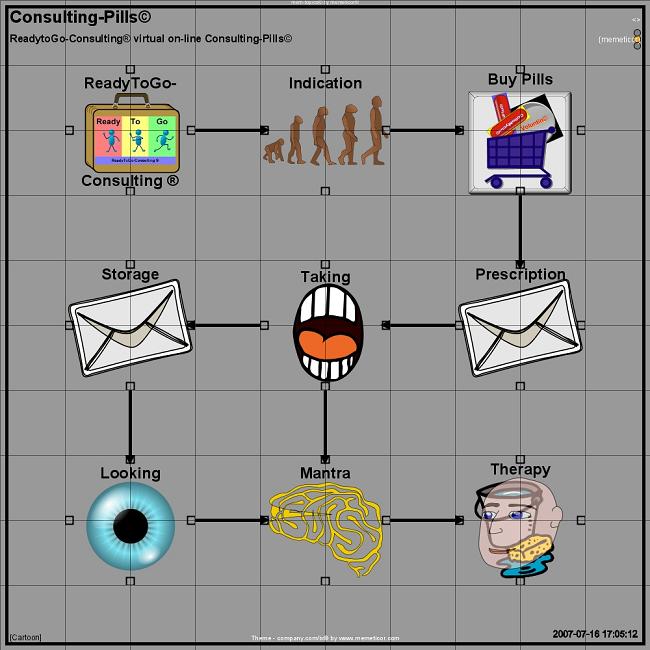
Consulting-Pillsİ We know it, but we do not heed it mostly.
To do so we have to cast off our "I", to let the "it" work.

Arrogance, shame, ambition, laziness, sorrows, ... prevent us from doing so.

We knew this already long, long time ago:
  • The secret of an extraordinary man,
    in most cases,
    is nothing than consequence. [Buddha]
  • Who will practise, will come to know,
    who will not practise, will not come to know.
    [from the ancient China]
You can also come to know this as the essence of TaiJi-Quan.

But to make it especially easy for you, you may now even
If you want to follow up your targets and ideas consequently,
you should draw them regularly!

ReadyToGo-Consulting®...
IT for your wellness, and not the other way round!

powered by e-mem©
Disclosure:
http://firmena-z.wko.at
Contact

More newsletters are here ...

You can unsubscribe this newsletter or change your preferences here
Imprint:
Dipl.-Ing. Werner Riegler
Bleriotgasse 13b
A-2700 Wiener Neustadt
July 2007